
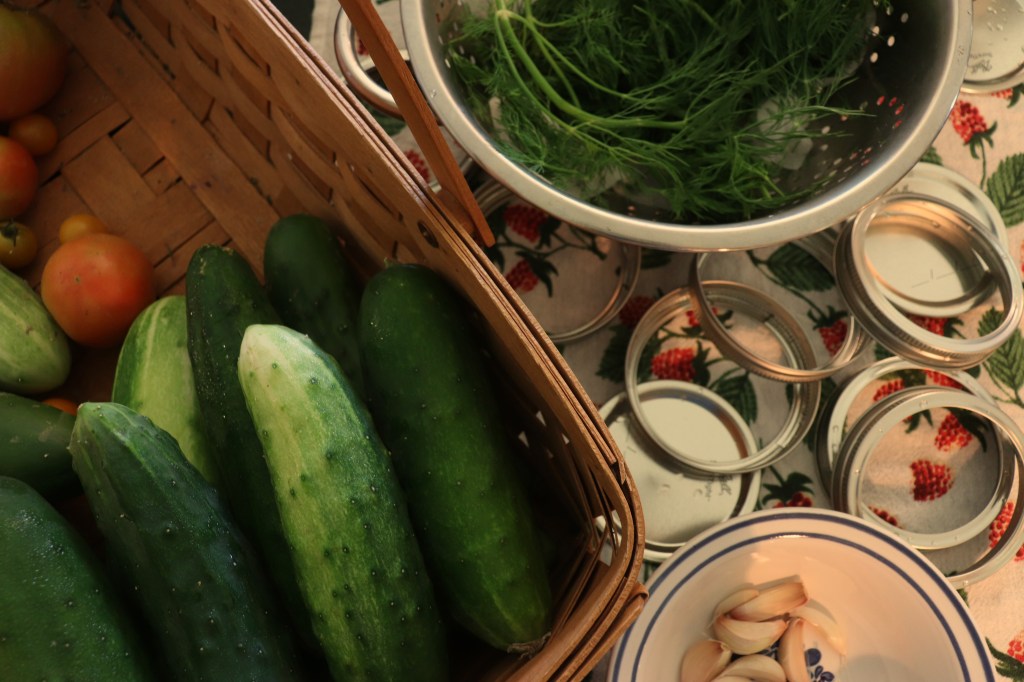
We saved pickling for the hottest afternoons in July, letting the big round thermometer beneath Papa Jay’s sunroom swing well over 90, the humidity souping up like the moss on his pond. It was a big job, with loads of cucumbers to harvest between our garden and Papa’s. Over a few weeks, Mom would save up all the pickings, spreading them out on a table in the basement until the afternoon when we loaded grocery bags of cucumbers into our red wagon and rolled it around the pond.
We pickled in Mema’s basement, where it was cool and there was a stove against the paneled wall next to her washer and dryer. And so Pickling Day was the smell of hot brine and garlic, mustard and dill, laundry detergent and the stale scent of the cold woodstove in the corner. This was before the older siblings married off, so all of us kids took up stations, some scrubbing cucumbers, some stuffing jars, some lowering them into the simmering brine. I always poured in the teaspoon of mustard seed, and if anyone else tried for the job, I fought them. Only the older boys got to handle the hot jars out of the oven, fitting cucumbers into them like ships in glass bottles.
I don’t remember how many quarts we’d put up in a day, but it was enough to fill our basement shelves and Mema’s too. We dated them and tucked them away, always saving a jar that would be pried open on Thanksgiving Day.
One year on Pickling Day, our family dog, Lucy, died. Dad had taken her to the vet that morning and come home without her, and we had trudged over to Mema’s to finish our work. We pickled that afternoon with heavy hearts. When we finished, we labelled the jar lids: “July 14th – Lucy’s Pickles.” Lucy’s Pickles would sit on our shelves for years, disappearing one-by-one, as we crunched through them and, oddly enough, remembered our gentle mutt. Until then, I’d only thought of canning as preserving food, not memories, but I suppose it is both.
But for Mema’s generation, canning wasn’t something done for nostalgia’s sake. She was born on the tattered hem of the Great Depression and was a curly-headed girl during World War II, when canning was actually touted as an act of patriotic defiance. Housewives were painted onto posters, shouting: “Can All You Can!” As a result, three-and-a-half billion quarts of vegetables and fruits were put up by Americans during the war.[i] It was not a hobby; it was a strategic maneuver.

“Can All You Can. It’s A Real War Job!” Poster, Office of War Information, 1943.
Collection of the National Archives and Records Administration (NAID: 513566).
I have to wonder what it was like taking a can off the shelf years after V-E Day. There would have been tomatoes and green beans on the dinner plate, and with them, the potent memories of food stamps, bombings, and loss. Maybe families ate pickled beets and missed the man at their table.
But mostly, canning seems to me like a great act of hope. “Putting up” quarts can only be done if you have faith that you (or your children) will take them down again. Canning vegetables in the middle of a war must have seemed like a mustard seed of faith that victory would come—like the Israelites gathering up manna, believing they’d live to see more on the ground tomorrow. In fact, God commanded them to “take a jar and put an omer of manna in it, and place it before the LORD to be kept throughout your generations” (Ex. 16:33). He wanted them to preserve it, to put it away for their children’s children, to remind them of Whom they served—a God who preserves and provides.
I don’t think it’s any mistake that canning took another jump in popularity after 2020. Folks realized they couldn’t always rely on the grocery store or government, but on their own kitchens and gardens. They started using their own hands to plant, pick, can, and put up quarts—either in fear or hope, I’m not sure. But I imagine that by now, they’ve taken down those jars, eaten their store, and tasted the goodness of the Lord. Years after the lost dog, the lost soldier, the changed landscape, He carries us on.
[i] Deseret News. When did canning become popular? 2023, Sept 24. From: https://www.deseret.com/2023/9/15/23827512/canning-trending-history/
 bethanyjlincks.com