
This piece was written for the February issue of our church newsletter, Grace & Peace.
Each year, I get a little better at remembering to plant bulbs. I wait until the garden has fallen asleep and the late chrysanthemums have stopped blooming, those first few frosts biting at their heads and turning them gray.
One day in November, as I was planting a bed of winter violets and bulbs, I talked to my grandpa Jay on the phone. When I told him what I was up to, he said that it sure seems like a strange time of year to plant flowers. He’s gardened for 50 years, and I agreed with him. The winds were starting to turn cold, Thanksgiving was coming, but I cut holes into the ground anyway like little graves.
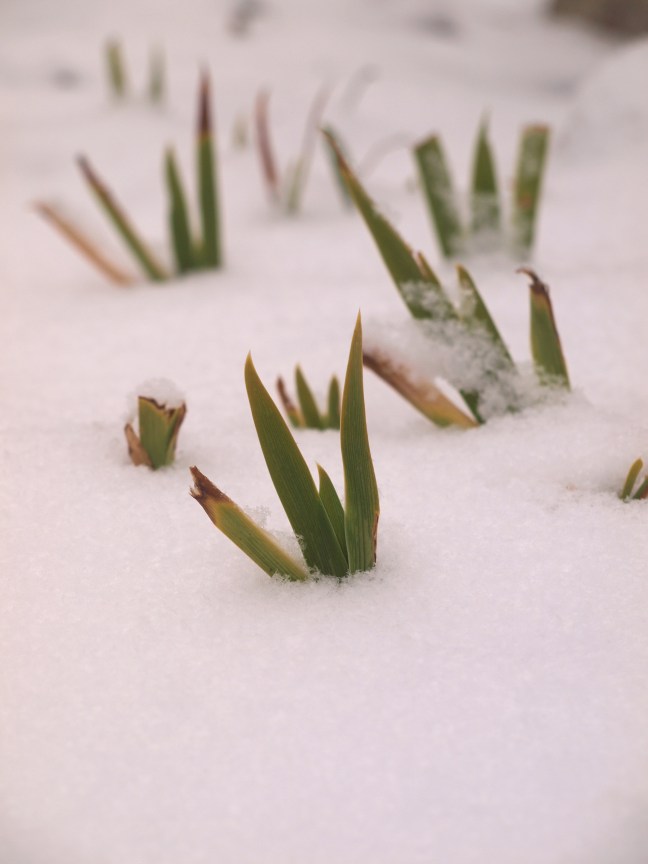
Bulbs remind me that God’s creation is resilient, that even under deep snow, there’s life at work. They remind me of something Samuel Rutherford wrote, that “Grace groweth best in winter.”
“I see grace groweth best in winter.” ~ Samuel Rutherford
When Paul wrote his letter to the Thessalonians, he began by giving thanks for the fruit this church was bearing—their “work of faith and labor of love and steadfastness of hope in our Lord Jesus Christ” (1 Thess. 1:3). Under the heavy snows of affliction, this church was receiving God’s Word and sending up shoots of new life (1 Thess. 1:6).
“For not only has the word of the Lord sounded forth from you in Macedonia and Achaia, but your faith in God has gone forth everywhere, so that we need not say anything” (1 Thess. 1:8).
The Thessalonians were living out the reality of the good soil in Jesus’s story of the seed and sower:
“As for that in the good soil, they are those who, hearing the word, hold it fast in an honest and good heart, and bear fruit with patience” (Luke 8:15).
Any gardener knows that the weather will always be changing, the seasons shifting, the snows will come. What matters is where you plant your seed and the soil you choose.
In their hearts, the Thessalonians were planted in the gospel of Jesus Christ. In location, they were planted in a city on a harbor–a bustling port of trade–so the fruit of their faith spread across Macedonia and Achaia and “everywhere.”
Where are you planted?
Where am I planted?
Where has the Lord rooted us in the ground, and what is the fruit He has called us to bear? Like the church on the seaport, your fruit may go far and wide, running down the rivers to the ocean, even to the ends of the earth. Maybe you’re more like the bulbs in my garden, and though you can’t see it yet, fruit is growing quietly, patiently, assuredly, just beneath the winter ground.
I walked outside today, and the snow is melting into the earth, and there they were–the yellow violets. Even under a heavy quilt of snow and ice, they must have been blooming all along.
 bethanyjlincks.com