
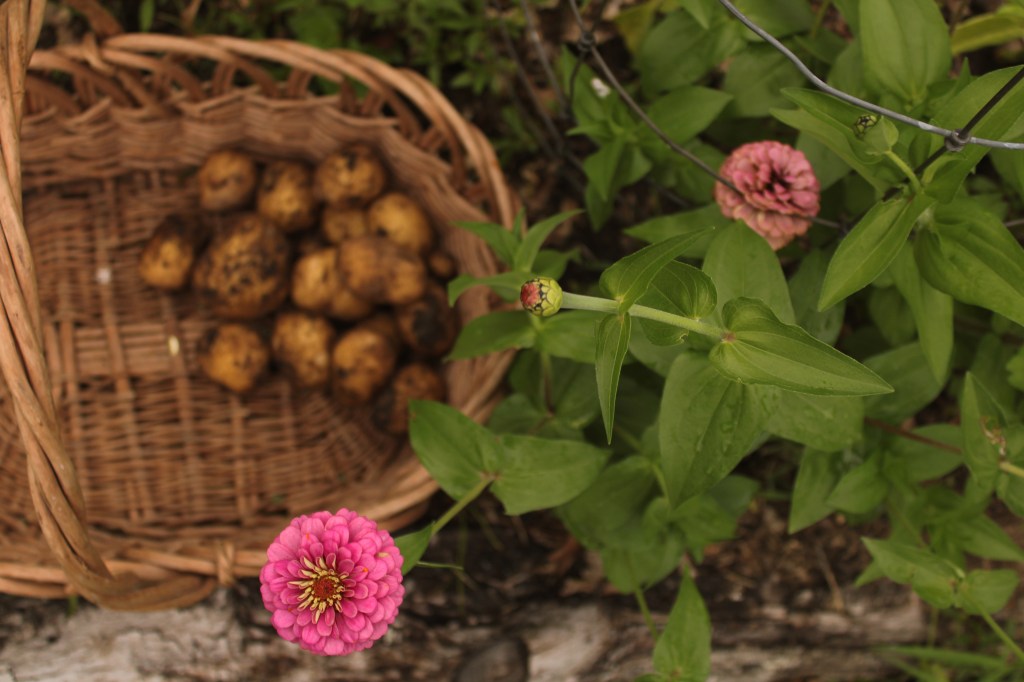
I was planting potatoes one day in early spring when what looked like two B-25 Mitchell bombers rumbled over the trees. I pulled my hands out of the dirt to watch history fly by and remembered there was an air show in St. Louis that weekend. I also remembered reading about the war gardens – or “Victory Gardens” – that women were marshalled to plant while men served on the front during the World Wars.
To ration food and importation costs during war, families across America and Europe turned their mown lawns into patches of beans and potatoes and corn. Magazine covers were heaped with images of green beans and canned tomatoes and slogans like: “Dig For Victory!” or “Can All You Can!” Companies distributed seed catalogs, newspaper columnists offered gardening hacks, and songs were sung, as folks were encouraged to turn their rose beds into rows of tomatoes:
Every seed is goin’ to grow into victory I know
with tomatoes where the roses used to grow.[i]
So gardening turned from a weekend hobby into a war effort. If families could put vegetables on the table from their own backyards, then metal cans could be recycled for ammunition. Crates could be spared aboard trains for more Ally supplies. The family might even be rationing an extra helping for their dad or brother in a ramshackle bunker across the sea. By gardening, wrote one American author, “You will have the satisfaction of knowing that you are doing your part in helping to win the war.”[ii]
But it must have seemed a little thing to pickle beets while the world burned; to plant potatoes with planes clattering overhead. If their gardens were anything like mine, they’d have wondered what three peppers, two green beans, and one basket of cherry tomatoes could possibly do in the face of starving armies, in the ashes of atomic bombs. In fact, I have wondered about it, because the world is still at war, and I’m on the home front wondering how potatoes and tomatoes can be of any earthly good. Am I really “Sowing Seeds Of Victory,” or am I just hiding in the foliage from it all?
War divides. It sends people running to their camps. Ally or Axis? The instances were sparse when someone straddled that line, and the war on God’s kingdom is no different. “Nobody is neutral,” my pastor said last Sunday. The mind that is set on the flesh is hostile to God (Rom. 8:7). The question is not whether we’ll be fighting, but whose flag it will be under—-the Kingdom of Darkness, or the Kingdom of His Beloved Son?
And so we’re all on the war front, called to arms—-or as the magazines of 1945 would say, “Called to Farms.” Our job at home, in the garden, is the job of the faithful soldier—-to fight weeds and sow seeds in faith that, even as we plant potatoes, the Great War is already being won.
“Share in suffering as a good soldier of Christ Jesus. No soldier gets entangled in civilian pursuits, since his aim is to please the one who enlisted him… It is the hard-working farmer who ought to have the first share of the crops.
Remember Jesus Christ, risen from the dead…”
~ 2 Timothy 2:3-4, 6, 8
[i] Gilbert Mills, Ted Rolfe, and Billy Faber, “There’ll be tomatoes where the roses used to grow.” Arrow Music: New York, 1945
[ii] Proskauer, Julien. ABC of Victory Gardens. New York: D. H. Bedford, 1943 qtd. in http://activismandadvocacy.pbworks.com/w/file/fetch/62747120/Victory%2BGardens.pdf
 bethanyjlincks.com
I love your observations in this! So beautifully written as always ❤
LikeLiked by 1 person
thank you so much.
LikeLike