
A True Story from Home
There it was, lying in a black case on the quilt like a closed casket.
“Well, open it,” she said quietly.
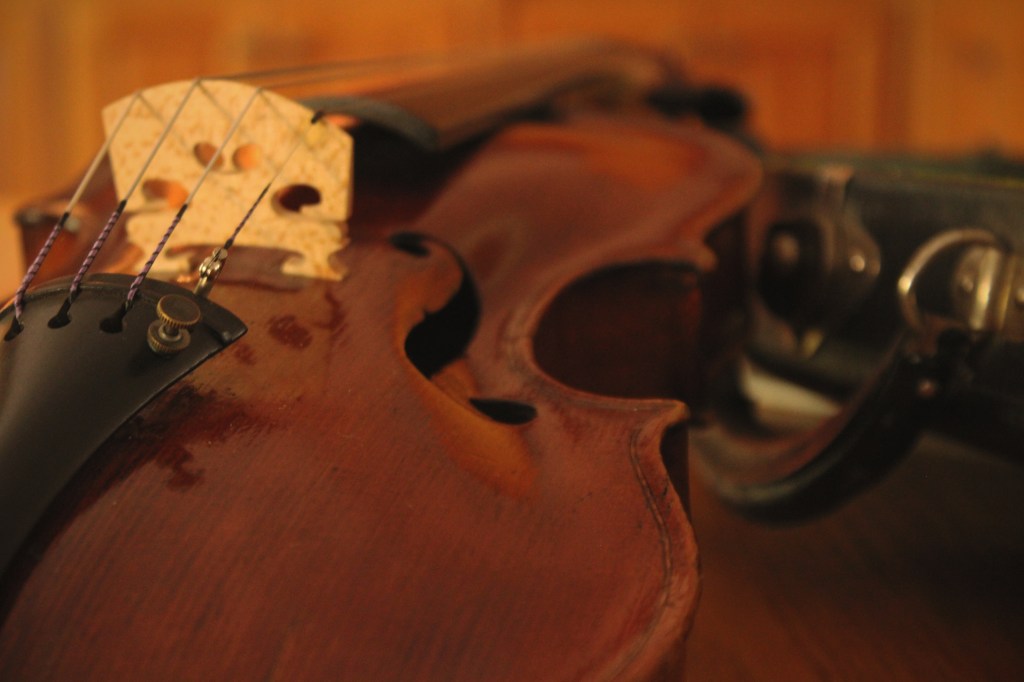
I unhitched the clasps and cracked it open to see a dark violin lying in green velvet. It was coated in dust and rosin, its strings were frayed, and the pegs had long slipped out of tune.
“My mother gave it to me,” she explained, “and I’ve had it here under the bed. It hasn’t been played in forty years.”
She gave a sad laugh.
Mrs. Barbara had seen me play the violin at church, so she knew I’d like to see it. I held it as gently as a baby, running my finger along the curves and down the cracks in the wood. When I plucked a string, it groaned like someone who’d long been asleep. I suppose it had been.
I noticed Mrs. Barbara’s hands were trembling a little as she reached into her pocket and unfolded a piece of yellow notebook paper. Her handwriting filled the page. She fixed a look at me from behind her glasses, then began to read the history she’d kept for all these years, safe with the violin.
. . .
“Bethany,
This violin belonged to my great-grandfather, John Shakespeare. He was a butcher and a musician.”
A butcher in 1890 would have had big hands. Hacking and hoisting slabs of meat required a man who could muscle a pig’s carcass onto a rack in front of his shop. It wasn’t work for the weak-stomached. To enter his shop door each morning, he stepped over a gutter that ran with blood. In fact, the whole place smelled of blood and raw hides.
John Shakespeare carried out his work as a butcher in the Market Place of Derby, England. He was a friendly man with a mustache that drooped over his beard, whom the townsfolk remembered as an “excellent, punctual” member of the Ashbourne Urban Council and who frequented the Cattle Market.
John came home from his work in the evenings to a wife and five children, and I imagine this is when he took up his violin. He would have run his big thumb down the neck and tucked the instrument somewhere beneath his beard. In that moment, with the firelight staining the violin as red as the blood on his apron by the door, John Shakespeare looked like anything but a butcher.
On the morning of May 13, 1911, the Derby Daily Express ran a headline:
SUDDEN DEATH OF A PROMINENT ASHBOURNE TRADESMAN
John Shakespeare had died in his sleep. The Daily Express remembered him as a butcher, but also as “a violinist of marked ability, [who] frequently played for the old Ashbourne Orchestral Society… He leaves a widow, two sons and three daughters.”
John left something else—his bronze violin, which he called his “Duke.”
Richard Duke was a violin maker in London who was imitated more than anyone save Stradivari himself, so the chances that John owned an original Duke aren’t likely. But they aren’t impossible either.
. . .
“When John died, the violin was sent to my grandfather, William Shakespeare.“
Mrs. Barbara reached into the violin case and carefully slid out a creased envelope addressed to Mr. W. Shakespeare. Inside was a letter from his sister, Helen, sent across the sea from Worcester, England to Rutland, Vermont:
My dear William,
I cannot remember which of the violins I sent to you. I remember packing them up, one to you and one to John. Father had one he used to call his Duke. I wonder if yours is that one. I do not even remember if it was there when he died. Let me know what you think.
Helen
William Shakespeare was not artistic. He was not a poet or actor, and he was very likely not a violinist. He went by “Will” and worked for the Rutland Railway for nearly 50 years, being promoted to conductor, then train master. When a Vermont newspaper ran an article announcing William’s retirement, they made sure to clarify he wasn’t the real William Shakespeare:
“William Shakespeare, the train master, not the poet, has retired after nearly half a century on the Rutland Railway. The veteran railroader says ‘it’s hard to tell’ whether he is related, distantly or otherwise, to the famed Bard of Avon.”
The article said William planned to spend his time in retirement taking care of the lawn and flowers at his home on Park Avenue.
That’s how Barbara remembers him, as a particular man. He had spent his life in numbers and timetables, and when Barbara came to visit Grandpa Shakes as a girl, she remembers he would measure and weigh her to record her growth. During his years on the railroad, William had kept a meticulous pocket diary, where he’d record things like when he got a haircut and the day the U.S. declared war on Japan.
At home, he pinched pennies. After he died, his family found cash folded into books all around their Vermont home. To William, his father’s “Duke” must have seemed like inheriting a potential fortune. He likely tucked the violin into a closet, hoping that someday, it would be worth more than all the spare bills he’d stashed away.
. . .
“The violin was played by my mother, Mary, in the 1930’s,” Barbara’s note continued. “I played it in the 50’s and 60’s. None of us were accomplished musicians.”
Mary was like her father. She poked around on the piano and tried the violin, but she did not have an ear for music or an artistic flair. Mary’s new husband was a chemist and forward-thinker who shot about the country, taking Mary—and the violin—with him. The little black case would have traveled as far and wide as William himself on the railway—from St. Louis to Massachusetts to San Francisco to New York City and back to Missouri again. Maybe it was the bumping of travel and shifting climates that chipped and cracked the violin over the years, as it was slid under one bed frame, then another.
That’s where the violin had been at rest since Barbara herself played it. Her daughter had given it a try in high school as Barbara had, but she’d been like her mom. Barbara was a shy girl who could never see herself playing first chair in the Kirkwood High School Orchestra. She took lessons, but it was with dread that she stood before her teacher in his living room. After high school, Barbara tucked the violin away, got married, and settled into her life as a wife and mother. Like her great-grandfather John, she used her hands in the ordinary work of raising and feeding her family.
If the value of the violin as a genuine Duke was to be discovered, it would have been by now. In all the scrapes of travel, surely some hidden label would have bled through the instrument’s varnish. But there was nothing. Only a nameless, blank-faced instrument that was being lulled into a long sleep.
Barbara kept it anyway. Sometimes, she’d open the case just to look at it. She’d unfold Helen’s letter and read it again. It’s said that a violin will only sound as rich as often as it’s played, and it saddened her to watch her great-grandfather’s Duke—or replica of it—fall into silence.
But it is also said that, if played, a violin can be awakened again.
. . .
Mrs. Barbara had reached the end of her piece of notebook paper, and as she finished reading, her voice cracked:
“My hope is that if ever played again, this violin would be used to declare God’s praise. Do with it whatever the Lord leads you to do.“
I looked at her. She wanted me to have it. No, she wanted me to play it the way I played my own violin— to carry it into the church sanctuary and tune it up.
So I did.
I played the violin last Sunday behind the church piano, as we sang: “Come Thou fount of every blessing, tune my heart to sing Thy grace.” And by grace, the strings on the old violin did keep their tune. If I can help it, I’ll play the violin so fervently and often that the tone deepens and the wood earns a few more scars in the holy work of worship.
It may not wear the label of the luthier, Richard Duke, but this violin bears the marks of a butcher who loved it, a railwayman who kept it, and a mother who wanted to see her children play it—and now, it rings with the symphony of ordinary saints on Sunday morning, which really, is a song that will never end.
If the Lord wills, I’ll place this violin in the hands of my own children and say something like, “See this mark here? That was patched a long time ago in a little shop in England.” Or, “See this crack on the violin’s belly? That might have happened when the violin sailed to America, where it was given to Mrs. Barbara, and where she gave it to me.”
I might look into my daughter’s dark, little eyes and say, “I played many, many hymns to God on this violin. Here— let me teach you a few.”
 bethanyjlincks.com
Oh….Bethany. How could anyone not love this story. It makes one cry and smile all at once. Finding out that you played it last Sunday is so amazing. Thank you for sharing this wonderful story ❤️ …
LikeLiked by 1 person
🤎
LikeLike
wow. this is a beautiful story. and i loved hearing it in your voice. thank you 💛
LikeLiked by 1 person
🤎
LikeLiked by 1 person
What a beautiful story! I, too, have a violin that was given to me by my Aunt Grace when I was a child. She claimed it was a Stradivarius copy and was over 100 years old then. I played it through high school and have carried it around with me untouched ever since. I am hoping to give it to one of my grandkids some day!
LikeLiked by 1 person
ah, that is amazing! what a gift.
LikeLike
So beautiful loved hearing your voice read this and love that you are playing this violin. God has so gifted you…..to Him be praise and thank you.
LikeLiked by 1 person
thank you!
LikeLike
What a beautiful story and legacy to be wrapped up all in that one violin! The ending to this piece especially was touching – thank you for sharing, Bethany 🙂 May we all be instruments of God’s grace in the times and place He’s placed us in!
LikeLiked by 1 person
thank you! and amen.
LikeLike
You told this so beautifully, Bethany!! I really enjoyed it—thank you for sharing and highlighting this beauty. 💕
LikeLiked by 1 person
Thank you for reading, Hannah!
LikeLike