
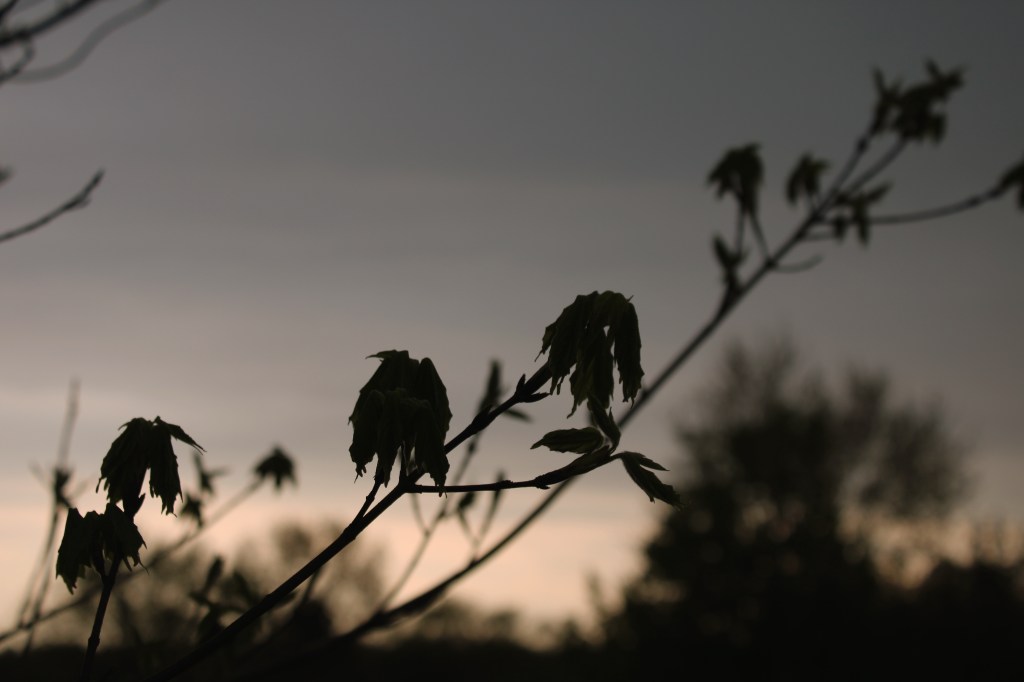
On the day the moon eclipsed the sun, I happened to be with Jared in Arkansas, where spring had brought the dandelions a little sooner and where the bees were busy at their hives. I also happened to be near totality, where, in the big, southern sky, the sun dwindled to nothing more than a curled shaving of light.
A few days before the event, I read this advice from another writer: Don’t just look up during totality, she said, but be sure to look down. Her point was that the sun’s tentacles reach into the crevices of creation, and when its light is suddenly drawn back, nature responds.
So I stood in the yard with paper glasses pressed to my face, then took them off to look down around me. As the moon crept over the sun, the dandelions began to close. Jared’s bees groaned in frustration—so loud he thought they’d swarmed. Another friend told me her chickens got confused and darted around in the twilight. I read that during the 1991 eclipse, spiders dismantled their webs, and in 2017, birds changed their course of migration during the span of two minutes. People migrated, too, as the highway traffic toward the path of totality looked like a flock of southbound geese.
I remembered back to 2017 when, in the heat of a midsummer’s day, the shadows lengthened and the crickets sang as if dusk had fallen. It wasn’t just a strange thing for the creatures, but for us as humans, too.
Light is how we live and move and have our being. God created day and night before he created man, so we simply entered into a pattern that already existed, and our bodies likewise fell into rhythm. In fact, our circadian rhythm is an internal clock that reacts naturally to light. When the sun rises, our eyes let it in and our body temperature rises to awaken us. When night falls, our body temperature drops, and our system closes up in sleep like a dandelion. It’s beautiful, really, the way our bodies rise and fall and respond to the God-ordained liturgy of day and night.
But what happens when the light disappears in the middle of the day?
I wonder what happened to the circadian rhythm of the bees and dandelions when darkness fell over Jerusalem for three hours during the afternoon (Luke 23:44). Some will call it an eclipse, but it was far too dark and far too long for that. I wonder if birds returned to their nests and bees to their hives. I wonder if the myrtle blooms in Gethsemane closed. I wonder if people looked down to see the shadows fall as the Light of the World gave himself up in death. I wonder if they went home, thinking night had fallen.
I suppose it had, but not forever.
On the day the sun was eclipsed, creation groaned, but only for a few minutes. And when it had passed, the light grew stronger and clearer, the bees set out to forage again, the birds sang, and the flowers unfolded themselves. When the veil lifted from Jerusalem on Sabbath morning and the Light of the World returned, Peter and John sprang back to life too. Mary’s eyes opened. Thomas emerged from the darkness of his doubts. People didn’t just look up to see their risen Lord, but they looked down and around to see his light bringing all creation to life.
Sources:
https://www.smithsonianmag.com/blogs/national-museum-of-natural-history/2024/04/08/when-the-moon-obscures-the-sun-how-does-life-on-earth-respond
https://www.sleepfoundation.org/circadian-rhythm
https://apologeticspress.org/was-the-darkness-of-the-crucifixion-merely-an-eclipse-545


Brilliant! Thank you for this, Bethany.
Thanks again, Vella Karman
LikeLiked by 1 person